Why your WordPress site is losing you clients?
Key takeaways — WordPress powers over 4 in 10 websites worldwide. But for a bespoke professional, a theme shared by thousands of businesses, a mobile performance score of 41/100, and SEO based on outdated rules are no longer enough. Here's why — and what the alternative looks like.
Design: you look like everyone else
When a potential client lands on your site, they don't read. They look. And they form an opinion in 50 milliseconds.
A Stanford study (Web Credibility Research, 2003) showed that visual design is the number one factor in website credibility — far ahead of content quality or relevance. In other words: form matters more than substance for the first impression.
The problem with WordPress is that most sites are built on pre-made themes. Your site looks like your competitor's, which looks like their competitor's. It's hard to project a premium image with a €59 template shared by thousands of businesses.
And when you try to customize? A real-world example: my father has a WordPress site with Elementor. Every time he adds a photo, it's a coin toss — sometimes the layout shifts, sometimes an entire section disappears. A tool meant to simplify things that, in practice, breaks the site with every change.
For an interior designer who creates bespoke spaces, a generic website sends exactly the opposite message of what you sell.
SEO: a slow site that Google ignores
Performance that kills your visibility
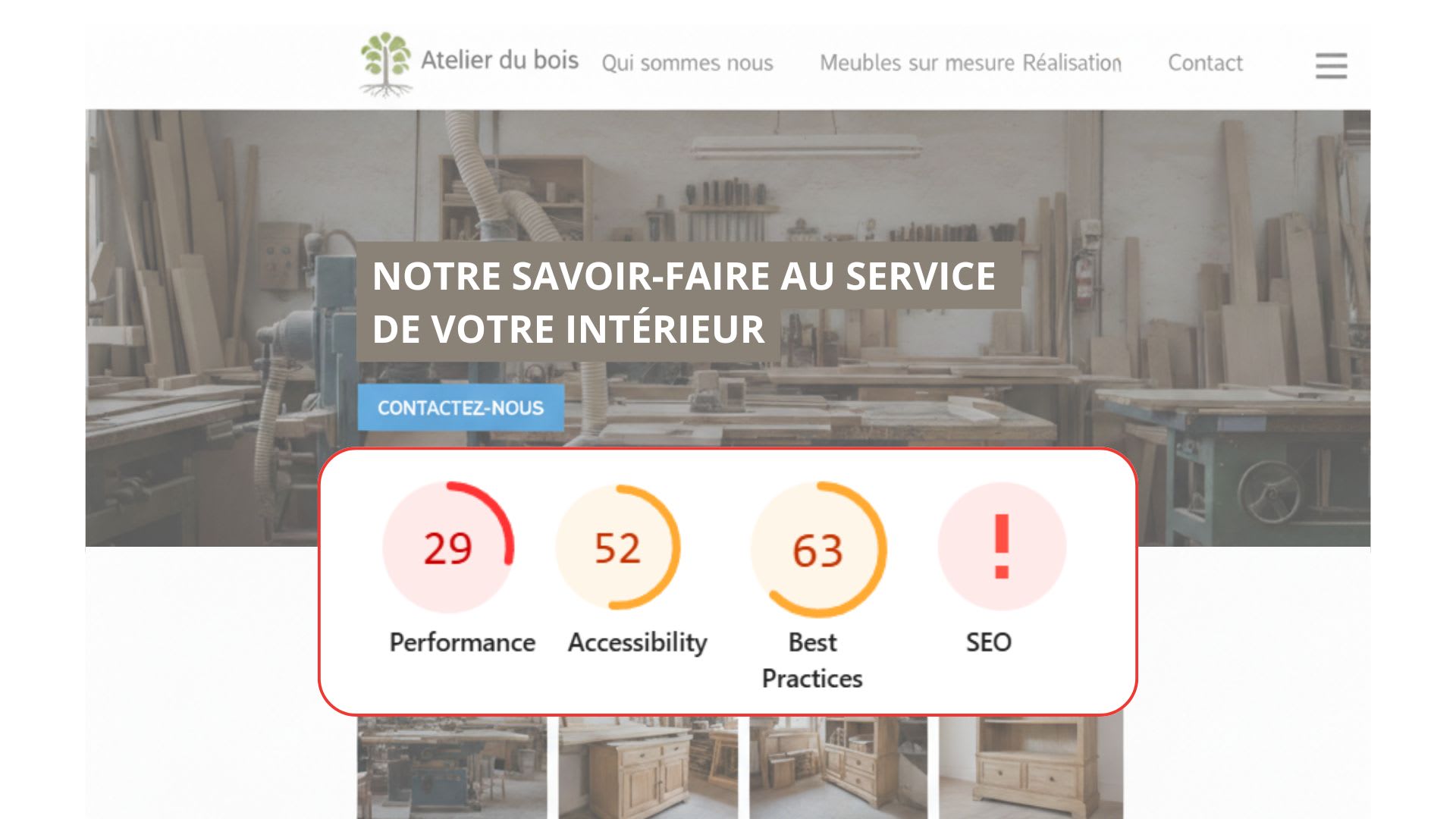
In 2025, the median Lighthouse score for a WordPress site on mobile is 41 out of 100 (HTTP Archive, Web Almanac 2025). Google considers an acceptable score to start at 90.
Why does this matter? Because 53% of mobile visitors leave a site that takes more than 3 seconds to load (Google / Think with Google). And because Core Web Vitals — the performance metrics measured by Google — are a ranking factor in search results.
The main culprit: plugins. The average WordPress site uses between 12 and 15. Each one adds code, scripts, and weight. The result: a sluggish site that Google pushes to the bottom of results.
SEO has changed, Yoast hasn't kept up
If you use WordPress for your SEO, you probably use Yoast. The plugin tells you to place your keyword a certain number of times, write short paragraphs, and gives you a green light when it's "optimized."
The problem: Google doesn't work like that anymore.
John Mueller, Google's spokesperson, has stated clearly: keyword density is not a ranking signal. He even described generic SEO content as "digital mulch" (PPC Land, December 2025).
What Google values today is E-E-A-T: Experience, Expertise, Authoritativeness, and Trustworthiness. Content that demonstrates real subject knowledge, written with your brand's tone and perspective, will always outperform generic keyword-stuffed text.
The proof: in 2024, Google's Helpful Content Update reduced low-quality content in search results by 45% (Google Blog, March 2024). Entire sites lost over 90% of their traffic overnight.
Yoast optimizes for rules from five years ago. Google evaluates your expertise.
The alternative: a site built to convert
A custom-built site by professionals changes the game on every front. Auréa brings together brand identity, SEO strategy and technical development under one roof.
A design that reflects who you are. When we created the site for Thomas Amoros, a sports coach, we didn't apply a template. We designed a visual identity aligned with his method and positioning — a brand that inspires trust from the very first second.
Native performance. Our own site, agence-aurea.com, scores 100/100 across all four Lighthouse categories: Performance, Accessibility, Best Practices, and SEO. The average WordPress site: 41/100 on mobile performance.
End-to-end SEO mastery. No stacking plugins, no bloated code. A clean technical architecture, native structured data, and strategic content that demonstrates your expertise — not keyword filler.
And most importantly: a site you can evolve without breaking everything.
WordPress vs custom site: the comparison
| Criteria | WordPress + theme | Custom-built site |
|---|---|---|
| Design | Template shared by thousands of sites | Unique, aligned with your positioning |
| Mobile performance | Median score: 41/100 | Score 95 to 100/100 |
| Customization | Limited, risk of breaking layout | Full control, every change is managed |
| Technical SEO | Plugins (Yoast), bloated code | Natively optimized architecture |
| Maintenance | Frequent updates, compatibility issues | Handled by the agency, you have nothing to manage |
| Security | Plugins = entry point for vulnerabilities | No third-party plugins, reduced attack surface |
Conclusion
The real cost of a WordPress site isn't the €5/month hosting. It's the clients who leave in under a second because your site doesn't reflect the quality of your work.
If you design bespoke interiors for your clients, your digital storefront deserves the same standard.